History
Origins
Despite its uncertain origin, we could place the creation of the Drac de Vilafranca between the 13th and 14th centuries.
Historically, the Drac belonged to the Confraternity of Sant Miquel, founded in 1331, initially under the patronage of Sant Francesc, at the convent that the Franciscan monks had outside the urban centre of Vilafranca, on what is now Carrer de Sant Pere. This confraternity was made up of cobblers, packsaddle makers, tanners and curriers.
Shortly afterwards, the confraternity moved to the church of Santa Maria, and came under the patronage of Sant Miquel. In 1335 we find that the altar of Sant Miquel already had a benefice at Santa Maria. The chapel of the Confraternity of Sant Miquel Arcàngel, according to the pastoral visit of 1367, occupied the first chapel of the apse on the Epistle side. Subsequently, in 1584, we find it at the first chapel of the apse on the Gospel side, where today the chapel of the Blessed Sacrament is located.
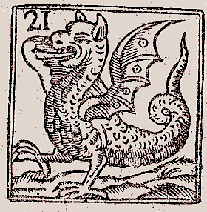
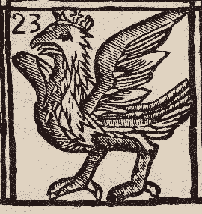
The church, with the institution of Corpus Christi in the 13th century, incorporated different beast figures such as the eagle, the lion, the mulassa, the ox, the víbria, the cotonines and the dragon. Little by little these elements take on a life of their own, adopting their own symbolism and meaning, until they are finally incorporated into Catalan festive culture with a distinct function. Over time they came not only to accompany religious celebrations but also popular civil festivities.
Apart from the Corpus procession, throughout the rest of the year there were other special dates in Vilafranca. In 1562, the feast of the Virgin of the Assumption began to be celebrated on 15 August, which until the Festa Major in honour of Sant Fèlix was established in the 18th century, was the most important festival of the year together with Corpus Christi.